
Transportation Funding: From Neutral Ground to Battleground

Visible damage to deck of I-35 in Duluth, MN


As I discussed in an earlier post, there’s a growing local and national backlog of critical transportation infrastructure projects—with no funding in sight.

Consensus Actually Exists

You might be interested to know that all branches of the federal government, from both sides of the isle, agree that we are not investing properly now for the transportation needs of the future.

To put this in perspective, the U.S. is spending approximately 4 to 5 times less on infrastructure than other countries are, including developing nations like China and India.

Since our interstate highway system was built in the 1960s, government expenditures on infrastructure have fallen to just 2.4 percent of GDP. In contrast Europe invests 5 percent of its GDP on infrastructure and China 9 percent.
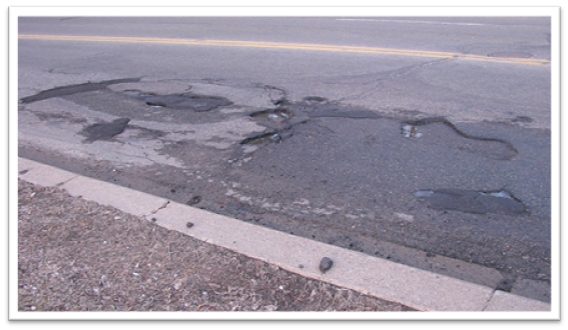
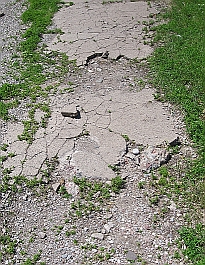
Pothole as an example of transportation infrastructure that needs funding to maintainAs a result, the United States Is now ranked twenty-third overall for infrastructure quality, between Spain and Chile.

Political Will Does Not

Not so long ago, spending tax dollars on infrastructure was not nearly so political and divisive as it is today.  Roads, bridges and railways used to be neutral ground on which the parties could come together to support the country’s growth. In 1991, the federal transportation bill (the Intermodal Surface Transportation Efficiency Act, termed ISTEA for short), passed both branches of Congress by nearly a 5 to 1 margin.

Fast forward twenty years.
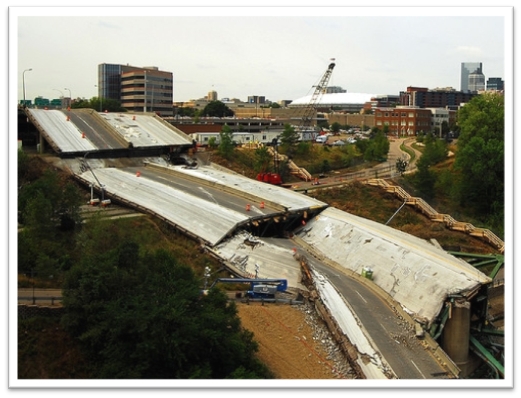
I-35 bridge collapse in Minneapolis, MN, Today’s gridlock in Washington has resulted in years of legislative limbo.  Transportation funding has been limping along under a series of short-term extensions and appropriations because Congress can’t agree on what should be included in the new transportation bill—and hasn’t figured out how to pay for them either.

The consequences of this inaction are severe. Crumbling bridges and roadways and increased congestion will not only be expensive problems to solve in the future, but will also have a cost in the increased amount of time we spend on substandard roads.

Our nation’s economic future relies on its ability to deliver goods and services, a task that is increasingly more difficult as our highway system falls into disrepair. Without action, our nation’s economic competitiveness will diminish.

While the urgency of the problem is plain to all – the political will to fix it isn’t there.

It Will Get Personal

And the hard part is, it’s not just our politicians who will need to make some attitude adjustments.  All of us, as users of the transportation network, will need to be willing to make a shift in how we think about paying our way.

Mileage-based fees, not motor fuel taxes, are the fairest way to assess the costs and benefits to the users of the system.  BUT…

Solutions Exist

There are many options, ideas and technologies available to us to pay for the transportation system we need, now and into the future.

But they will take some getting used to.  I’ll talk about them in my next blog post.  Stay tuned.

Pothole photo credit: David Erickson
 
 
I-35 photo credit: Marion Doss
 

My Awesome Walk to Work

Snow-covered section of the Superior Hiking Trail in Duluth MN

My Facebook post today reads: “Another awesome walk to work this morning on the Superior Hiking Trail—despite the snow—or maybe because of it!”

Within seconds a friend (an actual friend, in this case) responded “I did the same. I love Chester Park.”

Another commented “You are the luckiest commuter ever!”

This exchange reminded me of the simple, real-life benefits of one of our favorite concepts here at the MIC: multi-modal transportation networks.

It’s all about options

From a transportation planning perspective, a multi-modal transportation network refers to a balance of  infrastructure that supports multiple modes of travel — a mix of roads, air, marine/port, rail, public transportation, bicycle and pedestrian facilities (including paved and non-paved trails).  This mix is plainly visible on any given day in the Duluth-Superior area.

From a societal and governmental perspective, multi-modal transportation networks have been widely supported because a balanced transportation system encourages economic growth, reduces congestion and environmental impacts, and improves mobility and access to transportation.

From my personal perspective, though, a multi-modal transportation network means that I have options. It was just too nice of a morning to get in my car and drive (the very walkable distance of) two and a half miles.

Trails as commuter pathways

One big advantage of living in Duluth, Minnesota, is the proximity of urban areas to green spaces. A multi-modal system, in this city, means that I can walk out my back door onto the Superior Hiking Trail, which in turn intersects with our urban streets infrastructure across Skyline Parkway (as scenic a walk as you could ask for), down through a couple of local neighborhoods and to our downtown office.

And a community-wide vision is emerging for Duluth to become the premier trail city in North America. Developing an inter-connected trails system will provide not just outstanding recreational opportunities but compelling transportation options as well.

Quality of life improvement

Bottom line, I don’t have to get in my car and drive every time I need to go somewhere. I’m able to travel on foot (or by bike or by bus), and I consider that a big quality of life enhancement.

How about you?

Do you have an awesome walk to work of your own?  Would you like to be able to walk or bike more often in your daily life?  Does it make sense to continue to fund multi-modal transportation networks? (More on that topic to follow…)

Getting Everyone on Board: Coordinating Transit for Human Services

An updated transit plan for the Arrowhead Region has just been released for public review.  It’s a plan that’s aimed to coordinate resources and cover more ground with less.

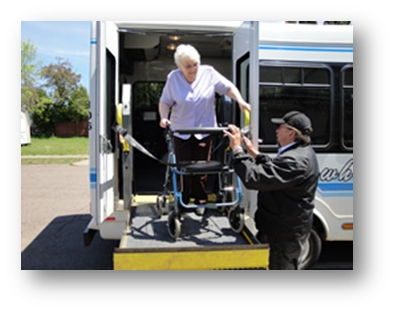
Woman with walker being assisted by the driver of a lift-assisted bus in Duluth, MNThe 2011 Local Human Service Transit Coordination Plan for the Arrowhead Region outlines broad strategies as well as specific project ideas to help the transportation-challenged – elderly, disabled, and low-income – get to medical appointments, services and jobs.

The strategies and project ideas identified in the plan will be used to set priorities and support competitive bidding for certain Federal Transit Administration (FTA) funds that are dedicated to assisting these groups.

Leveraging shared transportation resources

The Arrowhead Region comprises seven large, mostly rural counties – 10,635 square miles!  Providing transportation services throughout this enormous area is a daunting prospect.  And a few economic trends are making this challenge evermore daunting:

1)  A large percentage of the region’s population is entering old age (and reduced income)

2)  The per/mile cost of service (particularly due to fuel prices) has been increasing at a significant rate while

3)  Federal and state transit assistance is facing significant cuts.

And that’s where the value of this transit plan comes in –  to leverage existing resources (vehicles, drivers, etc.), to provide services more efficiently throughout the region with those limited resources.

Regional coordination is the essence of this plan

Many of the strategies identified in the coordinated transit plan call for projects that create more resource-sharing opportunities, or create “one-stop-shop” call centers that can assist with organizing and lining up ride opportunities.

Perhaps the most important project idea in the plan, however, is to convene a regional coordination body, bringing together the region’s service providers every year to continue to find ways to work together to overcome challenges. And that’s a big move forward!

Draft plan is open for comment

Can you think of another way to take on the daunting challenge to get everybody on board?

This plan is open for public comment until 11/10/11.  For those of you interested, the plan can be reviewed on ARDC’s Regional Planning website.

Photo credit: Arrowhead Transit

Kicking the Can Down the Road

Can of Worms Intersection in Duluth,MN

Are you hearing (or perhaps voicing) complaints about delays on area roadways, road construction or the high price of gas?

Statements like “with the price of gas so high they should lower the gas tax”?

Of course, throw in the usual “all the roads in this area are in terrible shape.”

It seems that we, the traveling public, want to have it all: safe bridges, smooth roads, no construction delays—all at less cost.

A “Can of Worms” – Indeed!

The problem is, it takes time to reconstruct and maintain our infrastructure and it costs a lot of money to do so.

And the backlog of needed projects is growing.

Right here in Duluth, where the I-35 reconstruction project will cost a total of $81 million over two-plus years, the “can of worms” interchange, which contains 31 individual bridges, will also need repair and restoration to the tune of an estimated $250 million.  This will become a critical infrastructure need within the next 10 to 20 years–with no funding source yet identified.

Do (Lots) More with (Lots) Less

Today we are asking our road authorities (at the city, county and state) to do more with significantly fewer resources.

You may have heard by now of a recent survey by the Rockefeller Foundation, which found that two-thirds of the American public felt that a greater investment is needed in transportation infrastructure. Fully 80 percent of those surveyed agreed that spending on highways and bridges would produce jobs and economic growth, yet only 38 percent thought that federal spending should be increased and only 27 percent said that federal gas taxes should be raised to support this spending.

What the survey tells me is that we, as transportation planners and policy makers, have done a horrible job of helping the public understand transportation needs, transportation funding, and the consequences of failing to invest in transportation infrastructure.

Investing in transportation infrastructure supports multiple societal purposes besides our personal mobility, including American economic competitiveness, public health, environmental sustainability and energy independence.

If not addressed, many types of costs will be pushed out into the future.

What will our future generations say about this practice?  How happy would we have been if previous generations had done this to us?

Our Love/Hate Relationship with Central Entrance

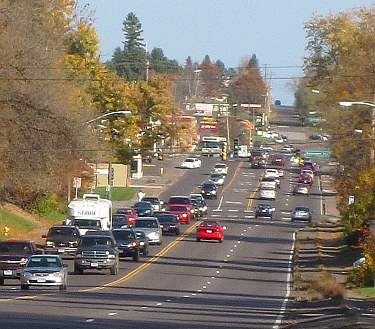
Just last week I dropped a friend off near Arrowhead Road and Highway 53 just before 8 a.m. and headed toward my office in downtown Duluth.  I glanced at the dashboard clock and it said 7:58.  I had anticipated a congested trip but traffic was fairly light.

Love It

I made my way downtown thinking about my upcoming work day, scored a (free) parking spot, and to my surprise saw my car clock said 8:05.  Seven minutes to go five miles on Central Entrance, of all routes.  I had to admit that was an easy and direct commute.

Hate It

Fresh in my memory, however, are recent after-work trips to Miller Hill to run errands where I waited out more than one cycle of traffic light changes at Arlington Road and Central Entrance.  I–like everyone else–get frustrated by sitting in traffic.

But I think that we get frustrated much quicker than big city drivers who have horror stories about the amount of time they get stuck in traffic.  Relatively speaking, we have it pretty good.  So what is it about Central Entrance that makes many of us want to avoid it?

The Bigger Picture

From a transportation standpoint, it’s not just about reducing vehicle congestion on this road, but about balancing the needs of all users.  In transportation planning, we think about  improving Central Entrance from many perspectives, including:

  • Mobility (getting travelers through the area)
  • Access (getting customers to local businesses)
  • Multimodal (accommodating pedestrians, bicyclists and transit users)
  • Safety (for all)
  • Livability (for neighborhood residents)

Someday (The Vision)

The City of Duluth has been thinking about these things as well.  A long term vision for Central Entrance was recently identified, with input from businesses and residents, in its Central Entrance-Miller Hill Small Area Plan.  The vision for the corridor is for a more walkable area that would regain its focus as the “main street” for the Duluth Heights neighborhood.

Where We Come In

As a step toward implementing the plan, the City has asked the MIC to examine the transportation challenges on the Central Entrance corridor.  We will be collecting data, surveying residents, and making recommendations that will help in achieving the goal of eventually transforming Central Entrance into a more comfortable and attractive part of town.

There will be more information posted via this blog as our work progresses, but meanwhile, you can get more information about the Central Entrance Corridor study on our website.

Your Thoughts?

So what do you think about Duluth’s neighborhood-oriented vision for Central Entrance?  Can you picture a balanced transportation system like I describe above?


What Makes an Award-Winning Bike Map?

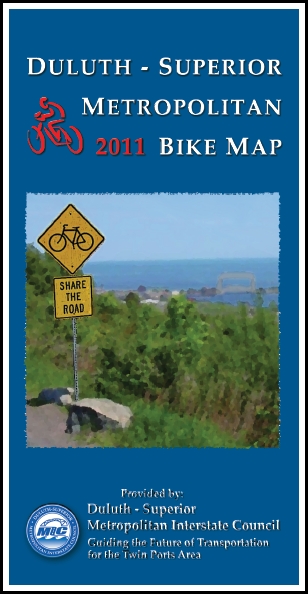
Congratulations to our GIS Specialist Kody Thurnau. His redesign of our popular Duluth-Superior Metropolitan Bike Map took not one but two awards from juries of his peers at the 2011 Esri International User Conference in San Diego, CA.

The map was awarded first prize in the category Best Cartographic Design Single Map Product – Large Format Press Copy.  Judged by 38 Esri staff members for general and specific cartographic quality, entries in this category had to be a single map product larger than 11 in. x 17 in. but not exceeding 48 in., printed professionally on a printing press.

The map was also one of three overall winners of the Cartography Special Interest Group (Carto SIG) Map Awards, out of 1,200 conference Map Gallery entries.

Judging criteria included ‛efficiency in communication of intended message’ and ‛maximization of the user’s cognitive experience.’  More specifically, the judges appreciated:

  • Its compact size
  • Its design, layout and the way it’s strategically folded
  • Its scale and legibility
  • Its topographical info
  • Its easily identified green space destinations
  • Its urban area destinations, including local bike shops
  • Its information about different riding surfaces
  • Its information about designated bike routes

In other words, it’s perfectly designed to for people who want to bike in, around or between Duluth and Superior, whether you’re a recreational rider or an urban commuter.

Your guide to biking Duluth and Superior

You can pick up own copy of the Duluth-Superior Metropolitan Bike Map at local bike shops, tourist information outlets or email us at dsmic01@gmail.com and we’ll mail you a copy.

Next up: online interactive version

Right now we have a pdf version of the map available for you to download on our website.  Never fear, Kody is hard at work converting the print version into an interactive map you’ll be able to access and use online.

Great Lakes Short Sea Shipping (try saying that fast three times)

Steven Fisher, Executive Director of the American Great Lakes Ports Association, made the case for the value of the Great Lakes navigation system and discussed the legislative and regulatory issues posing challenges to the maritime industry at the MIC’s annual meeting on July 20, 2011.

Fisher noted that throughout the United States, road and rail congestion threaten economic growth and quality of life. Transportation planners (including the MIC) are examining how short sea shipping via the Great Lakes can ease some of the burden on the land-based transportation modes.

View Fisher’s discussion of all topics (4:39)

Safe, Cost-Effective, Environmentally Sustainable

Fisher asserted that waterborne transportation has demonstrated that it is the safest, most fuel efficient, cost-effective and environmentally sustainable mode of moving goods in the global economy. Vessels on the Great Lakes burn significantly less fuel and produce fewer emissions and have far fewer accidents than trains or trucks.

Great Lakes Harbor Dredging

Bottom line: there’s not enough money to properly dredge many Great Lakes commercial harbors.

Most ports require regular dredging to remove sand and silt that naturally accumulate in shipping channels. This work is the responsibility of the U.S. Army Corps of Engineers, but its FY 2012 budget only provides $22.4 million to dredge Great Lakes navigation channels, less than half the amount necessary.  As a result, many ports are becoming difficult for ships to navigate, and in some cases, shipping channels have become blocked and two are slated for closure.

Congress should provide adequate funds in the Fiscal Year 2012 Energy and Water Development Appropriations Bill to address the backlog of dredging projects at Great Lakes ports,

Harbor Maintenance Trust Fund and Political Gridlock

Bottom line: The money being collected from waterborne commerce is not dedicated to commercial ports.

The Harbor Maintenance Tax is a fee collected from domestic commercial cargo loaded or unloaded from vessels using US ports in order to fund the Army Corps of Engineers’ operation and maintenance activities. This includes the dredging that is needed to keep the Great Lakes ports up and running.

Despite the fact that adequate revenue (approximately $1.3 billion annually) is being collected, Congress has traditionally used about half of the fund’s money to offset general spending. Fisher noted that although there is significant support in Congress to enact legislation to ensure that funds collected for harbor maintenance are spent for their intended purpose, the current political gridlock in Washington DC is hindering the progress of this initiative.

View Fisher’s discussion of Great Lakes dredging and funding (1:16)

Aquatic Invasive Species and the Great Ships Initiative

Bottom line: there is widespread agreement in both the maritime industry and the environmental community that the best way to prevent the transfer of aquatic invasive species is to keep them off ships in the first place. For that reason, there is considerable research being done to develop technology to treat ballast water and remove or kill aquatic nuisance species.

In 2007, the Great Ships Initiative (GSI) opened the world’s first fresh water ballast treatment technology test facility, located in Superior, Wisconsin.

View Fisher’s discussion of the GSI (1:13)

Future of the Shipping Industry on the Great Lakes

Bottom line: both the US and Canada are continuing to invest in the future of the shipping industry on the Great Lakes.

The Great Lakes St. Lawrence Seaway, which is managed and operated jointly by Canada and the United States, is a unique and significant navigation route into the North American heartland for deep-draft vessels coming from the Atlantic Ocean and beyond.

Fifty years after its construction, both countries recognize that it provides important economic benefits by transporting cargoes such as grain, iron ore, and steel into and out of the Great Lakes region. Recent policy changes in Canada have spurred $400 million investment in rebuilding its Great Lakes fleet.

View Fisher’s discussion of future prospects for the GL maritime industry (1:05)

Photo credit, Laker in Duluth Canal: Minnesota Extension Service, Don Breneman

Photo credit, Laurentian Great Lakes: NOAA, Great Lakes Environmental Research Laboratory

Video editing: Brian Heaton

You Have Feet. Walkable Neighborhoods Encourage You to Use Them.

In our previous post about the Lincoln Park Pedestrian Plan, we talk about the goal of making it a “walkable” neighborhood.  And you might be asking (with good reason) what does “walkable” or “walkability,” mean, anyway?

Walkability is basically “planner-ese” for how easy and safe it is for a pedestrian to move through an area.  And now you might ask, so what?

Walkability = A Whole Range of Benefits

When a street is welcoming to walkers, a whole range of benefits to society appear. Be they health, environment, or social—getting people out of their cars and onto their feet does our community good. When everyday travel can be done on foot, people exercise without ever technically “working out.” With fewer cars on the road emitting toxic fumes, the whole community breathes cleaner air. And with more people out in the community chatting with each other, community bonds are strengthened.

Why Don’t More People Walk, Then?

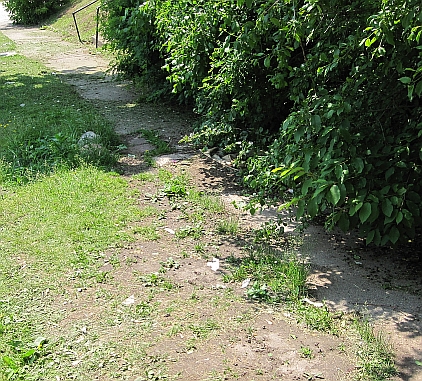
Walking is, well, not always the easiest option in Duluth. Aside from the fact that the city is located on a giant hillside (some avenues gain as much as 700 ft of elevation), there are other problems. In some places the sidewalk network is obstructed by overgrown vegetation or missing sections. In other places there are roads that pedestrians frequently need to cross but lack crosswalks, signals, or signage at the intersections. Our freezing-cold winters and piles of snow don’t make it any easier, either.

The benefits are clear though, and well designed streets to can go a long way toward the city comfortable and safe for people on foot.

Safety

Personal safety and security is perhaps the greatest concern for most people as they consider walking over driving. Most people won’t walk in settings in which they feel a threat, real or perceived, to their personal well-being.

Heavy, speeding traffic and big, wide roads can create an environment that is downright hostile to pedestrians. That is why it is so important to have a pedestrian infrastructure such as a complete, well maintained sidewalk network and crosswalks.

Walkability Audit

An important tool that planners use to understand—and improve—the walkability of a neighborhood is called a walkability audit. This is an actual, physical walk through the neighborhood along a predetermined route. The planners carefully observe the street and evaluate what they see according to a set of criteria (Sidewalks? Crosswalks? Obstructions? Safety hazards?). Once these observations are noted, they are discussed and eventually serve as the basis for recommendations for how to improve walkability of the study area.

These recommendations will ultimately be included in the final pedestrian plan, which, like others, will be used by local government and community groups for how public improvements and private developments should be planned for from this point forward.

 Stay Tuned

We’ll be conducting a walkability audit for the Lincoln Park Pedestrian Plan later this week. The hope is that if we can determine and encourage the best route up and down the hill, many more kids will be able to walk and bike to school and other popular destinations.

Check back soon to see the group’s findings.

 photo credit: Ian Britton

First Steps toward a Walkable Lincoln Park

It takes more thought than you might expect to move people safely from the top of the hill to the bottom and back again.

Lincoln Park Pedestrian Study

This summer the MIC and area non-profits have partnered to do a pedestrian study of the Lincoln Park Neighborhood of Duluth. The study will look at the way that people who walk and bike (especially school-aged children) move up and down the hill, with the aim of finding and encouraging the best possible route between the site of the New Lincoln Park Middle School and the Duluth Heritage Sports Center and the proposed Cross City trail.

It’s a short study, slated to be completed in just six weeks.

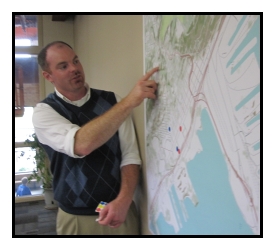
A diverse group of community groups, led by MIC Senior Planner James Gittemeier (pictured) and assembled by Cliff Knettel, Executive Director of NHS Duluth, all share the view that a well designed pedestrian plan benefits the entire neighborhood.

Other study participants include the Engineering department for the City of Duluth, Fit City Duluth, Local Initiatives Support Corporation of Duluth (LISC), and neighborhood volunteers.

Walking, not just Talking

Looking at maps and discussing best routes is one thing, but getting out there on the ground is another.  Study committee members will perform a walkability audit of the paths most likely to be used by students.

Findings of the audit, along with its recommendations, will serve as the basis for the Lincoln Park Middle School Safe Routes to School grant application for the 2012 round of applications. Safe Routes to School is a federally funded program that promotes children walking and bicycling to school by funding targeted improvements to bicycle and pedestrian infrastructure in school areas. Duluth has received a number of these grants in the past.

Stay tuned for more information as this study moves forward.

Nobody Knows the Sidewalks I’ve Seen

Duluth Sidewalk Inventory

You might have seen a wiry, long-haired fellow wandering the streets of Duluth staring intently down at his phone over the last few weeks. That guy is me, the MIC’s intern for this summer. And that phone is actually a GPS device called a Trimble Juno. I’m using it to record the condition of every section of sidewalk in the city. With my trusty GPS in hand (which I call Lil’ Julie) I walk slowly through the streets recording three different bits of information for the Duluth Sidewalk Inventory.

Condition Rating

The first is the sidewalk condition rating. The options are Excellent, Good, Fair, and Poor. “Excellent” is basically for brand new sidewalks, immaculate and brilliant white. “Good” means that they don’t have any cracks and haven’t sunken or heaved. “Fair” means that there are cracks and vegetation growing up through those cracks. They generally have some sunken or tilted sections that leave small raised edges. “Poor” sidewalks are pretty rough. These have major surface defects—broken pavement, big holes and the like.

Curb Ramps

The second criterion is the condition of the curb ramps. A curb ramp is that sloped portion of sidewalk on each corner. It allows disabled persons to transition from the street level to the sidewalk level and vice versa. These are rated along the same scale as the sidewalks. Some sidewalks don’t have curb ramps at all. In situations like that the sidewalks are almost entirely inaccessible to disabled persons.

Obstructions

The third thing that I do is note any obstructions in the sidewalk. These generally consist of raised edges greater than ¾” and overgrown vegetation; though sometimes I do spot obstructions like raised utility access panels or signs in the sidewalk.

Targeting Scarce Resources

It’s not an easy job (did you know there are over 400 miles of sidewalks in Duluth?), but it really is important information to collect. With this data the city can target its resources to the spots that are in greatest need of repair. Lots of people, young and old, able-bodied and disabled persons alike, depend on these sidewalks for their own personal mobility and freedom. It’s good to know that the MIC’s sidewalk inventory works toward improving that.

Do You Have Your Own Examples?

Follow my progress on the MIC’s Facebook page. I’ll be posting updates on my progress all summer and adding pictures in the Unhappy Sidewalks of Duluth photo album. Do you have some real gems in your neighborhood? Some epic branches blocking your morning run? We’re also looking to identify sidewalk segments—in any condition, good or bad—that are important because they’re so heavily used.

Take a picture and post it to our wall or email it to me.

Roads, Trails, or Both?

Priorities for Duluth’s Transportation System

As discussed in our previous blog, approximately $45 million in federal funds are being programmed for Duluth area transportation projects for 2012-2015.

The draft Transportation Improvement Program (TIP) spells out costs and timeframes for a total of 36 high-priority projects over four years and is now open for public comment.

Balancing the needs of all users

It seems we easily divide ourselves into those who drive versus those who ride the bus versus those who bike and so forth….an “us versus them” scenario.

Well, in reality the transportation system—and the public spaces they are a part of—are used by people in a much more complex way. You might drive to your job or to shop, but there will always be some amount of walking involved, from car to final destination and back again. You might use the sidewalks for walking from place to place, but also for stopping to talk to your neighbor in a common space. You might ride your bike down the big hill but put it on a DTA bus for the trip back up.

Looking through this lens, from the perspective of the users of the transportation system, you can see how this TIP has a major focus on how to really connect people in the safest and most efficient way possible. 

Continuing to fix the highways

Preservation work on the two major bridges is needed to refurbish the Blatnik (I-535) in 2012 and the Bong (US Highway 2) in 2014. These TIP projects not only have the highest price tags and but also will receive the most attention—yes, just when the I-35 reconstruction “megaproject” is finished, there will be several more years of high-profile road construction projects, on the bridges this time!

Improvements for those who walk, bike, or take the bus

While the highway projects are devoted solely to cars and trucks, funding is also included to provide a safe alternative to driving.  A paved pedestrian and bicycle pathway, running parallel to I-35, will connect the whole city from west  to east. The Munger Trail will eventually extend all the way to the Lakewalk by constructing short segments of a new Cross-City Trail each year. The popular Duluth Lakewalk will in turn be extended from 60th Avenue East to Highway 61, and then out to Brighton Beach up the north shore.

Funding for the Duluth Transit Authority will purchase new buses and provide operating support for both its regular route and STRIDE bus service.

And thanks to recent Complete Streets efforts in Duluth, local street projects will take into account how the roads are being used by people every day and will be designed accordingly.

The projects funded in the draft 2012-2015 Duluth area TIP balance the need to move vehicles efficiently with the needs of all people who use these public spaces, including those who utilize public transportation, those who traverse the roads by bicycle and those who are on foot.

Which makes sense to us – what do you think?

Now Accepting Comments on…What?

From now until Friday, June 24, the MIC is accepting public comment on the draft Duluth 2012-2015 TIP.  No, this TIP is not a hot piece of insider advice.  It’s a bureaucratic document, and admittedly it can be quite dry.  But it’s much more important than it sounds, and we think it will be of interest to you as something that impacts your day-to-day life.  Want to get a road repaved?  A trail built? A new traffic signal on a route you take everyday?  There’s a good chance that project has to make it through the TIP process first.

Transportation Improvement Program

TIP stands for “Transportation Improvement Program” and it’s an annual document that lists what local transportation projects will be receiving federal funding in the coming years.

The current TIP (2012-2015) for the Duluth area contains a total of 36 projects planned to receive approximately $45 million in federal funds.

In actuality, $45 million is just a portion of what’s being spent on transportation improvements in the region, with federal funds typically accounting for less than 25% of what’s spent on road improvements in Duluth in any given year.  And yet this federal money can have a very catalyzing effect.

80% Federal Funding = Incentive for Innovative Local Projects

It’s often this federal TIP money that incentivizes more comprehensive, and often more innovative projects.  That’s because local governments are only required to match those funds 20 cents to the dollar. Or another way to say it: the federal government funds 80% of the project.  This can make an improvement like the upcoming Cross City Trail (an exciting new link between the Munger Trail and the Lakewalk) a more feasible project for the City of Duluth to pursue. 

The other projects in this year’s TIP are aimed at preserving existing roads and bridges, as well as strengthening connections among alternative modes of transportation.

Virtual Public Meeting – Seeking Your Questions and Comments

You can take a look at the list of Duluth area projects for 2012-2015 and consider using Open MIC like a ‘virtual’ public meeting by leaving us any questions or comments you might have about the projects.

Public comment period runs until Friday, June 24, 2011.

Freighter Ballet

I spotted these two ships earlier this season, conducting a maneuver to enable both boats to enter the Duluth-Superior harbor with only one lift from Duluth’s Aerial Lift Bridge.

Preserving a Landmark

At first glance, the ballet these two ships performed looked like a demolition derby on a massive scale but turned out to be an impressive display of seamanship on a beautiful spring day.

The result fits nicely with a plan by the City of Duluth to lessen wear and tear on the bridge by reducing the number of times the bridge lifts each day.

The plan, recently approved by the US Coast Guard, was aimed at recreational boaters limiting them to entering only on the half hour from 7 a.m. to 9 p.m. from May 27 to the Tuesday after Labor Day.

The system was tested last year and it reduced the number of lifts by over 1,000, a 23% reduction.  This not only saves wear on the Aerial Lift Bridge but also reduces roadway congestion on Canal Park and Park Point.

The bridge will still lift on demand for traffic like these freighters – but it was nice to see they are willing to do their part to preserve the iconic bridge.

Moving Stuff by Water – Cheaper, Safer, Greener

We were reminded at today’s National Maritime Day celebration at the DECC that maritime transportation is vital part of the national and our own local economy.

Waterborne transport efficiently moves both bulky natural resource materials and finished goods to global destinations.

Jim Weakly, president of the Lake Carriers’Association, in his keynote address, pointed out that Without water transportation the cost of all goods would be much higher.  Moving bulk goods by water is the most efficient, least costly, safest and most environmentally friendly method of transportation.  If water transportation was not available, all of those goods and materials would have to move by land which would increase congestion and cause higher levels of air pollution due to increased fuel use.

The Forgotten Mode?

Maritime transportation can be the forgotten method of moving goods and people—even here in Duluth, home of many a boat nerd.  Ships are visible to the general public when they are in port but while in transit may be many miles from shore and it’s out of sight, out of mind.

Here in the Twin Ports, iron ore from the Minnesota Iron Range moves to steel mills in the lower Great Lakes. Grain from western Minnesota and the eastern Dakotas moves to destinations throughout the world.  Nationally and internationally, finished consumer export and import goods arrive and depart from our coastal ports.  Almost everything we consume has at some point moved by water.

National Maritime Day

Originally held in observance of the value and importance of the U.S. maritime industry, National Maritime Day commemorated May 22, 1819, when the SS SAVANNAH sailed from her home port of Savannah, Ga., bound for Liverpool, England, becoming the first steam vessel to cross the Atlantic Ocean.  The observance later became more of a day to honor merchant mariners and merchant marine veterans, primarily those involved in WWII and other armed conflicts around the world.

Today, through efforts of numerous organizations including the Propeller Club of the United States, National Maritime Day is observed as a combined salute to merchant mariners, merchant marine veterans and the entire maritime industry, focusing attention on the benefits maritime brings to America’s economy, trade, national security, employment, environmental protection, recreation and quality of life.

M/V Hon. James L. Oberstar

The Interlake Steamship Company has announced the renaming of the ship Charles M. Beeghly in recognition of the Hon. James Oberstar, retired United States Congressman from the State of Minnesota.  The naming of the ship is in recognition of Congressman Oberstar’s work toward improving maritime transportation in the Great Lakes.  A ceremony christening the newly named ship will be held harbor side of the DECC on Tuesday May 23 at 10:30am.

Bike To Work – With a Little Help from the DTA

Tote Your Bike on the DTA

Friday, May 20th is Twin Ports Bike to Work Day.  If you’ve stopped short of riding your bike around Duluth because of the prospect of riding back up it, the DTA (Duluth Transit Authority) can help with that.

 A growing trend

You’ve probably seen the DTA driving around the Twin Ports with bikes mounted to the front of its buses for a while now, but did you know the DTA has been providing that service to its riders since 1994?  In 2009, with input from local bike riders and sustainability groups, the DTA made the decision to keep the bike racks on their buses all year round, a move which has helped to increase the number of bikes the DTA transports yearly from 0.48% of its total passenger trips in 2006 to 0.72% in 2010.

Now, 0.72% may not seem like a big deal, but it represents nearly 23,000 bikes being bused around the Twin Ports on an annual basis, and that’s an impressive number when you consider the challenging terrain, inclement weather and unfriendly temperatures we often encounter around these parts!  Yet, it’s those very conditions which make DTA bike racks worth celebrating.

Best of all, your bike rides for free. Using a DTA bus to transport your bike doesn’t cost anything more than the price of your bus fare.  More information about routes, fares and schedules is available at the DTA website.

Options, Options, Options

We at the MIC are all about improving your transportations options here in Duluth and Superior.  If you’re looking for alternatives to high gas prices and driving your car, here are five choices for you to consider right now.  And you can add the DTA’s bus-mounted bike racks to your list of alternatives for local travel this season. 

Considering that May is National Bike Month, why not participate and use the DTA’s bus-mounted bike racks as a way to support your commute?

Who, Me, Bike to Work? Yes, You!

When is the last time you smelled the lake air during your morning commute?

Or pulled into the parking lot with a big smile on your face, pumped with endorphins and ideas? Or lost a few pounds just by traveling back and forth to work every day?

Likely never, if you slide behind the wheel of your vehicle each morning.

But what if one day you left the car in the driveway and rode a bike instead?

On Friday, May 20th, we invite you to ride your bike to work. To reward your commute, we’ll have a couple of bicycle stations open from 6:30 am to 8:30 am with

  • Coffee, water and refreshments
  • Bike mechanics to look at brakes, tire pressure and other safety checks
  • Advance copies of the new and improved Duluth-Superior Bike Map

The bike stations will be located at:

  • Lake Ave & Superior Street in Duluth (Minnesota Power Plaza)
  • Tower Ave & Belknap Street in Superior (City Center Park)

Give biking to work a try – for just one day. Stop by and say hello.

Detour Ahead: Find Out Exactly Which Streets You’ll Have to Avoid This Construction Season

Congratulations, you have survived another winter in Duluth-Superior!

Coming soon…the construction season.

Work has already resumed on the I-35 Mega Project, but many other city, county, and state projects are scheduled for the Duluth-Superior area this year, including:

  • Midway Road (U.S. Hwy 2 – MN HWY 194)
  • West Skyline Parkway around Enger Park
  • 21st Avenue East;
  • Arrowhead Road from Kenwood to Rice Lake Road
  • Martin Road from Howard Gnesen Road to Rice Lake Road
  • U.S. Hwy 2/Belknap Street from Hill Avenue to East 2nd Street

Click on the “plus” sign on the map, below, to zoom in and then click on the traffic cones for details about specific projects:

View Larger Map

Give it a try and tell us what you think.

Driving Less is Green, Sassy and Good for You

A view from an awesome local bike commuter

Not to mention, much cheaper. With gas prices approaching $4 a gallon – here’s our top five suggestions for easing the pain at the pump.

1. Bike to Work
Biking as a transportation option—to get to work or to run errands—is low-tech, fun, healthy and easy on the environment. Check out the Minnesota Bike Commuter blog for some local inspiration and the Zen Habits blog for some attitude adjustment.

We’re also updating our Duluth-Superior Area Bike Map — stay tuned for the new one, due out in time for Bike to Work Day on Friday, May 20, 2011.

2. Walk
Walking to work is even simpler than biking. It’s a fabulous, no-tech way to stay healthy and save money on commuting costs. For the price of a decent pair of shoes, you can enjoy the natural beauty of this place that we love and reap numerous health benefits. It just takes a little planning to make it work for you.

Also, check out the Duluth Sidewalk Inventory the MIC will conduct during the summer of 2011, to improve the pedestrian environment around town.

Finally, check out the cool tools on the Walkscore.com website to map out your walking distance to restaurants, bars, parks, book stores, coffee shops and more.  Figure out what really is within walking distance, hills included.

3.  Get on the bus – for free.
Did you know the DTA began running its West Mainline express service again? During the I-35 construction season, people commuting into downtown from the West now have an opportunity to ride round-trip for free from now until October.

Check out this cool Google mapping application to find DTA routes and schedules for your destination.

4.  Drive partway
If you’re driving in from a distance, try parking at one of the DTA’s Park and Ride lots and ride a bus to work from there. There are three Park and Ride locations in Duluth and one in Cloquet to ride via LCS Coaches.  Parking is free and fares are reasonable.

5.  Trip chain
Remember when you got your chores done all at once so you could go out and play?  Trip chaining is the same idea. Here are some trip chaining facts to consider:

This is because emissions are highest when a vehicle is started “cold.” Starting a 5-mile trip when the engine is cold generates about 17% more nitrogen oxides and 50% more volatile organic compounds than the same trip when the car is started warm.

So pick your best option, and try something besides driving.  Tell us how it went!

Photo credit: MnBicycleCommuter

A Lot Has Changed Since 1993…Except the Federal Gas Tax

According to MinnesotaGasPrices.com, the average statewide price this week is $3.85 per gallon and rising.

Ouch.

But how much of the price at the pump is due to federal taxes?  It may be less than you think.

The United States federal excise tax on gasoline is 18.4 cents per gallon (24.4 cents for diesel fuel)—and has remained the same since 1993.  Since it’s a flat rate (not a percentage of the price, like a sales tax), tax revenues do not rise even if gas prices do.

This means the buying power of these revenues is significantly less that it was18 years ago.  That’s like you never seeing an increase in your paycheck to match inflation…since 1993.

Estimates by the Wisconsin Transportation Development Association suggest that the federal government would need to increase the tax to at least 28 cents per gallon just to recapture the purchasing power lost to inflation since 1993.

In this era of “no new taxes” and calls for streamlining government, I know that the topic of the gas tax is a controversial one.  But as a deadline looms for the reauthorization of the federal surface transportation program, it’s no wonder that funding is such a stumbling block.

Is raising the gas tax worth it to you?

Are safe, driveable roads worth $9 a month to you?

A large majority of Americans think spending on transportation infrastructure is important, according to a recent national poll.

It’s interesting to note, however, that the majority also opposes paying more of their own money to improve or modernize our transportation systems.

  • 80 percent believe that improving and modernizing transportation systems will boost local economies and create jobs.
  • Seventy-one percent oppose an increase in the gas tax.
  • Sixty-four percent oppose new tolls on existing roads and bridges.
  • Fifty-eight percent oppose paying a fee based on the number of miles they drive.

I can certainly sympathize with these respondents, who are feeling the pinch of a tight economy and reacting accordingly.  I know gas prices at $4.00 inspire a lot of anxiety in plenty of people, myself included.

However, my recent trip to the Transportation Development Association conference in Madison highlighted the issue of the federal gas tax that helps to build, repair and maintain a first-rate nationwide transportation infrastructure.

The gas tax is currently a flat rate of 18.4 cents per gallon – the same as it’s been since 1993. Unfortunately, prices of asphalt and other road-building materials haven’t held so steady, so the budget for keeping roads safe and efficient is approaching a breaking point.

TDA has pointed out that an increase in the federal gas tax by 10 cents per gallon would cost the average family $9 more a month.  Are faster, safer commutes and trips worth that much to you?

Or perhaps the better question is, for critical transportation infrastructure–where would you prefer the money come from?

Guiding the Future of Transportation and Planning – With Your Input


We need your input to help us accomplish our mission: ”Guiding the Future of Transportation for the Twin Ports Area.” Our job is to think ahead and plan for ways that federally-funded infrastructure investments can improve the ways we travel around this area — not just on roads, but also on foot, by bike, and on the bus.

Part of what we do is to seek out and incorporate ideas and information from area residents, elected officials, planners and engineers from all local jurisdictions (city, county, state and township). With your input we can encourage good local policy decisions and put forward projects for federal transportation funding that will enhance livability and optimize the movement of people and goods within the Duluth and Superior metropolitan area.

That’s where this blog comes in. We’re looking forward to speaking with you about everything transportation-related going on in the Twin Ports. If you want to be alerted when we start posting content later this month, just drop your e-mail into the slot on the right that says “Want This Blog Via Email?”

And we’re already talking with you on Facebook.  To join us there, just click on the link here.http://www.facebook.com/dsmic

Bye for now.  Hope you’ll stay tuned and become part of the conversation.